•  
Tie-Dye Technique Of Bai Ethnic Group - Chin

Tie-Dye Technique Of Bai Ethnic Group - Chin

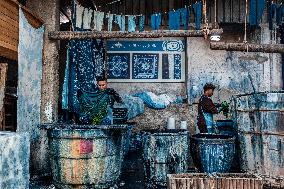
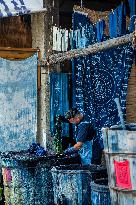
Duan Yuan, an inheritor of the tie-dye technique of Bai ethnic group, makes tie-dye designs in a dyehouse in Zhoucheng Village of Dali Bai Autonomous Prefecture, southwest China's Yunnan Province, November 21, 2025. Known as the hometown of the tie-dye technique of Bai ethnic group, Zhoucheng Village hosts over 200 households engaging in tie-dye businesses, with the number of employees exceeding 4,000. As a traditional folk technique of the Bai ethnic group, tie-dye boasts a history spanning over a thousand years and was included in the first batch of China's national intangible cultural heritage list in 2006. Tying and dyeing are the core steps in the process of making indigo tie-dye products. Artisans use needles and threads to create various patterns on the fabric, which are then dyed with plant-based dyes, resulting in blue backgrounds adorned with vivid white patterns. Photo by Hu Chao/Xinhua/ABACAPRESS.COM

  •  
Tie-Dye Technique Of Bai Ethnic Group - Chin

Tie-Dye Technique Of Bai Ethnic Group - Chin

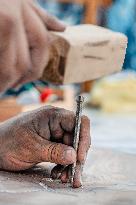
Duan Yinmei, an inheritor of the tie-dye technique of Bai ethnic group, creates knots on fabrics in a dyehouse in Zhoucheng Village of Dali Bai Autonomous Prefecture, southwest China's Yunnan Province, November 21, 2025. Known as the hometown of the tie-dye technique of Bai ethnic group, Zhoucheng Village hosts over 200 households engaging in tie-dye businesses, with the number of employees exceeding 4,000. As a traditional folk technique of the Bai ethnic group, tie-dye boasts a history spanning over a thousand years and was included in the first batch of China's national intangible cultural heritage list in 2006. Tying and dyeing are the core steps in the process of making indigo tie-dye products. Artisans use needles and threads to create various patterns on the fabric, which are then dyed with plant-based dyes, resulting in blue backgrounds adorned with vivid white patterns. Photo by Hu Chao/Xinhua/ABACAPRESS.COM

  •  
Tie-Dye Technique Of Bai Ethnic Group - Chin

Tie-Dye Technique Of Bai Ethnic Group - Chin

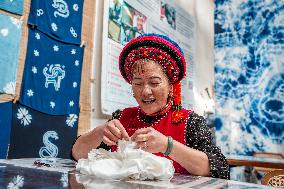
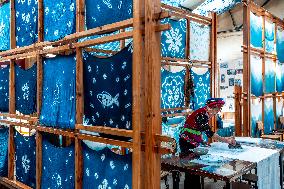
A woman experiences the tie-dye technique of Bai ethnic group in a dyehouse in Zhoucheng Village of Dali Bai Autonomous Prefecture, southwest China's Yunnan Province, November 21, 2025. Known as the hometown of the tie-dye technique of Bai ethnic group, Zhoucheng Village hosts over 200 households engaging in tie-dye businesses, with the number of employees exceeding 4,000. As a traditional folk technique of the Bai ethnic group, tie-dye boasts a history spanning over a thousand years and was included in the first batch of China's national intangible cultural heritage list in 2006. Tying and dyeing are the core steps in the process of making indigo tie-dye products. Artisans use needles and threads to create various patterns on the fabric, which are then dyed with plant-based dyes, resulting in blue backgrounds adorned with vivid white patterns. Photo by Hu Chao/Xinhua/ABACAPRESS.COM

  •  
Tie-Dye Technique Of Bai Ethnic Group - Chin

Tie-Dye Technique Of Bai Ethnic Group - Chin

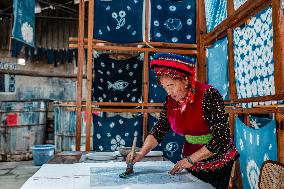
Duan Yinmei, an inheritor of the tie-dye technique of Bai ethnic group, dyes patterns on fabrics in a dyehouse in Zhoucheng Village of Dali Bai Autonomous Prefecture, southwest China's Yunnan Province, November 21, 2025. Known as the hometown of the tie-dye technique of Bai ethnic group, Zhoucheng Village hosts over 200 households engaging in tie-dye businesses, with the number of employees exceeding 4,000. As a traditional folk technique of the Bai ethnic group, tie-dye boasts a history spanning over a thousand years and was included in the first batch of China's national intangible cultural heritage list in 2006. Tying and dyeing are the core steps in the process of making indigo tie-dye products. Artisans use needles and threads to create various patterns on the fabric, which are then dyed with plant-based dyes, resulting in blue backgrounds adorned with vivid white patterns. Photo by Hu Chao/Xinhua/ABACAPRESS.COM

  •  
Tie-Dye Technique Of Bai Ethnic Group - Chin

Tie-Dye Technique Of Bai Ethnic Group - Chin

Duan Yuan, an inheritor of the tie-dye technique of Bai ethnic group, rinses dyed fabrics in a dyehouse in Zhoucheng Village of Dali Bai Autonomous Prefecture, southwest China's Yunnan Province, November 21, 2025. Known as the hometown of the tie-dye technique of Bai ethnic group, Zhoucheng Village hosts over 200 households engaging in tie-dye businesses, with the number of employees exceeding 4,000. As a traditional folk technique of the Bai ethnic group, tie-dye boasts a history spanning over a thousand years and was included in the first batch of China's national intangible cultural heritage list in 2006. Tying and dyeing are the core steps in the process of making indigo tie-dye products. Artisans use needles and threads to create various patterns on the fabric, which are then dyed with plant-based dyes, resulting in blue backgrounds adorned with vivid white patterns. Photo by Hu Chao/Xinhua/ABACAPRESS.COM

  •  
Tie-Dye Technique Of Bai Ethnic Group - Chin

Tie-Dye Technique Of Bai Ethnic Group - Chin

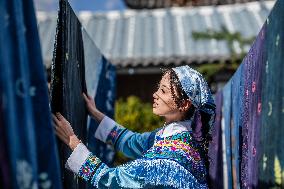
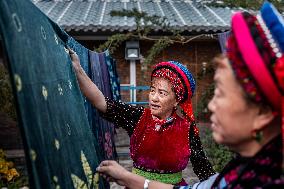
Duan Yinmei (L), an inheritor of the tie-dye technique of Bai ethnic group, and handicraftsman Duan Lilan dry tie-dye fabrics in a dyehouse in Zhoucheng Village of Dali Bai Autonomous Prefecture, southwest China's Yunnan Province, November 21, 2025. Known as the hometown of the tie-dye technique of Bai ethnic group, Zhoucheng Village hosts over 200 households engaging in tie-dye businesses, with the number of employees exceeding 4,000. As a traditional folk technique of the Bai ethnic group, tie-dye boasts a history spanning over a thousand years and was included in the first batch of China's national intangible cultural heritage list in 2006. Tying and dyeing are the core steps in the process of making indigo tie-dye products. Artisans use needles and threads to create various patterns on the fabric, which are then dyed with plant-based dyes, resulting in blue backgrounds adorned with vivid white patterns. Photo by Hu Chao/Xinhua/ABACAPRESS.COM

  •  
Tie-Dye Technique Of Bai Ethnic Group - Chin

Tie-Dye Technique Of Bai Ethnic Group - Chin

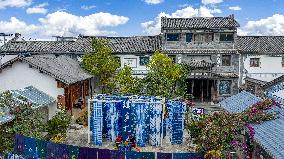
An aerial drone photo shows a scene at a dyehouse in Zhoucheng Village of Dali Bai Autonomous Prefecture, southwest China's Yunnan Province, November 21, 2025. Known as the hometown of the tie-dye technique of Bai ethnic group, Zhoucheng Village hosts over 200 households engaging in tie-dye businesses, with the number of employees exceeding 4,000. As a traditional folk technique of the Bai ethnic group, tie-dye boasts a history spanning over a thousand years and was included in the first batch of China's national intangible cultural heritage list in 2006. Tying and dyeing are the core steps in the process of making indigo tie-dye products. Artisans use needles and threads to create various patterns on the fabric, which are then dyed with plant-based dyes, resulting in blue backgrounds adorned with vivid white patterns. Photo by Hu Chao/Xinhua/ABACAPRESS.COM

  •  
Tie-Dye Technique Of Bai Ethnic Group - Chin

Tie-Dye Technique Of Bai Ethnic Group - Chin

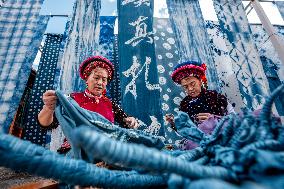
Duan Yinmei (L), an inheritor of the tie-dye technique of Bai ethnic group, and handicraftsman Duan Lilan untie knots on fabrics in a dyehouse in Zhoucheng Village of Dali Bai Autonomous Prefecture, southwest China's Yunnan Province, November 21, 2025. Known as the hometown of the tie-dye technique of Bai ethnic group, Zhoucheng Village hosts over 200 households engaging in tie-dye businesses, with the number of employees exceeding 4,000. As a traditional folk technique of the Bai ethnic group, tie-dye boasts a history spanning over a thousand years and was included in the first batch of China's national intangible cultural heritage list in 2006. Tying and dyeing are the core steps in the process of making indigo tie-dye products. Artisans use needles and threads to create various patterns on the fabric, which are then dyed with plant-based dyes, resulting in blue backgrounds adorned with vivid white patterns. Photo by Hu Chao/Xinhua/ABACAPRESS.COM

  •  
Tie-Dye Technique Of Bai Ethnic Group - Chin

Tie-Dye Technique Of Bai Ethnic Group - Chin

Duan Yinmei (L), an inheritor of the tie-dye technique of Bai ethnic group, and handicraftsman Duan Lilan untie knots on fabrics in a dyehouse in Zhoucheng Village of Dali Bai Autonomous Prefecture, southwest China's Yunnan Province, November 21, 2025. Known as the hometown of the tie-dye technique of Bai ethnic group, Zhoucheng Village hosts over 200 households engaging in tie-dye businesses, with the number of employees exceeding 4,000. As a traditional folk technique of the Bai ethnic group, tie-dye boasts a history spanning over a thousand years and was included in the first batch of China's national intangible cultural heritage list in 2006. Tying and dyeing are the core steps in the process of making indigo tie-dye products. Artisans use needles and threads to create various patterns on the fabric, which are then dyed with plant-based dyes, resulting in blue backgrounds adorned with vivid white patterns. Photo by Hu Chao/Xinhua/ABACAPRESS.COM

  •  
Tie-Dye Technique Of Bai Ethnic Group - Chin

Tie-Dye Technique Of Bai Ethnic Group - Chin

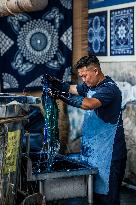
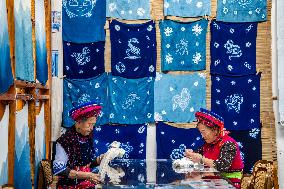
Duan Yuan (L), an inheritor of the tie-dye technique of Bai ethnic group, dyes fabrics in a dyehouse in Zhoucheng Village of Dali Bai Autonomous Prefecture, southwest China's Yunnan Province, November 21, 2025. Known as the hometown of the tie-dye technique of Bai ethnic group, Zhoucheng Village hosts over 200 households engaging in tie-dye businesses, with the number of employees exceeding 4,000. As a traditional folk technique of the Bai ethnic group, tie-dye boasts a history spanning over a thousand years and was included in the first batch of China's national intangible cultural heritage list in 2006. Tying and dyeing are the core steps in the process of making indigo tie-dye products. Artisans use needles and threads to create various patterns on the fabric, which are then dyed with plant-based dyes, resulting in blue backgrounds adorned with vivid white patterns. Photo by Hu Chao/Xinhua/ABACAPRESS.COM

  •  
Tie-Dye Technique Of Bai Ethnic Group - Chin

Tie-Dye Technique Of Bai Ethnic Group - Chin

Duan Yuan, an inheritor of the tie-dye technique of Bai ethnic group, makes tie-dye designs in a dyehouse in Zhoucheng Village of Dali Bai Autonomous Prefecture, southwest China's Yunnan Province, November 21, 2025. Known as the hometown of the tie-dye technique of Bai ethnic group, Zhoucheng Village hosts over 200 households engaging in tie-dye businesses, with the number of employees exceeding 4,000. As a traditional folk technique of the Bai ethnic group, tie-dye boasts a history spanning over a thousand years and was included in the first batch of China's national intangible cultural heritage list in 2006. Tying and dyeing are the core steps in the process of making indigo tie-dye products. Artisans use needles and threads to create various patterns on the fabric, which are then dyed with plant-based dyes, resulting in blue backgrounds adorned with vivid white patterns. Photo by Hu Chao/Xinhua/ABACAPRESS.COM

  •  
Tie-Dye Technique Of Bai Ethnic Group - Chin

Tie-Dye Technique Of Bai Ethnic Group - Chin

Duan Yuan, an inheritor of the tie-dye technique of Bai ethnic group, dyes fabrics in a dyehouse in Zhoucheng Village of Dali Bai Autonomous Prefecture, southwest China's Yunnan Province, November 21, 2025. Known as the hometown of the tie-dye technique of Bai ethnic group, Zhoucheng Village hosts over 200 households engaging in tie-dye businesses, with the number of employees exceeding 4,000. As a traditional folk technique of the Bai ethnic group, tie-dye boasts a history spanning over a thousand years and was included in the first batch of China's national intangible cultural heritage list in 2006. Tying and dyeing are the core steps in the process of making indigo tie-dye products. Artisans use needles and threads to create various patterns on the fabric, which are then dyed with plant-based dyes, resulting in blue backgrounds adorned with vivid white patterns. Photo by Hu Chao/Xinhua/ABACAPRESS.COM

  •  
Tie-Dye Technique Of Bai Ethnic Group - Chin

Tie-Dye Technique Of Bai Ethnic Group - Chin

Duan Yuan, an inheritor of the tie-dye technique of Bai ethnic group, dyes fabrics in a dyehouse in Zhoucheng Village of Dali Bai Autonomous Prefecture, southwest China's Yunnan Province, November 21, 2025. Known as the hometown of the tie-dye technique of Bai ethnic group, Zhoucheng Village hosts over 200 households engaging in tie-dye businesses, with the number of employees exceeding 4,000. As a traditional folk technique of the Bai ethnic group, tie-dye boasts a history spanning over a thousand years and was included in the first batch of China's national intangible cultural heritage list in 2006. Tying and dyeing are the core steps in the process of making indigo tie-dye products. Artisans use needles and threads to create various patterns on the fabric, which are then dyed with plant-based dyes, resulting in blue backgrounds adorned with vivid white patterns. Photo by Hu Chao/Xinhua/ABACAPRESS.COM

  •  
Tie-Dye Technique Of Bai Ethnic Group - Chin

Tie-Dye Technique Of Bai Ethnic Group - Chin

Duan Yuan, an inheritor of the tie-dye technique of Bai ethnic group, makes tie-dye designs in a dyehouse in Zhoucheng Village of Dali Bai Autonomous Prefecture, southwest China's Yunnan Province, November 21, 2025. Known as the hometown of the tie-dye technique of Bai ethnic group, Zhoucheng Village hosts over 200 households engaging in tie-dye businesses, with the number of employees exceeding 4,000. As a traditional folk technique of the Bai ethnic group, tie-dye boasts a history spanning over a thousand years and was included in the first batch of China's national intangible cultural heritage list in 2006. Tying and dyeing are the core steps in the process of making indigo tie-dye products. Artisans use needles and threads to create various patterns on the fabric, which are then dyed with plant-based dyes, resulting in blue backgrounds adorned with vivid white patterns. Photo by Hu Chao/Xinhua/ABACAPRESS.COM

  •  
Tie-Dye Technique Of Bai Ethnic Group - Chin

Tie-Dye Technique Of Bai Ethnic Group - Chin

Duan Yinmei, an inheritor of the tie-dye technique of Bai ethnic group, unties knots on fabrics in a dyehouse in Zhoucheng Village of Dali Bai Autonomous Prefecture, southwest China's Yunnan Province, November 21, 2025. Known as the hometown of the tie-dye technique of Bai ethnic group, Zhoucheng Village hosts over 200 households engaging in tie-dye businesses, with the number of employees exceeding 4,000. As a traditional folk technique of the Bai ethnic group, tie-dye boasts a history spanning over a thousand years and was included in the first batch of China's national intangible cultural heritage list in 2006. Tying and dyeing are the core steps in the process of making indigo tie-dye products. Artisans use needles and threads to create various patterns on the fabric, which are then dyed with plant-based dyes, resulting in blue backgrounds adorned with vivid white patterns. Photo by Hu Chao/Xinhua/ABACAPRESS.COM

  •  
Tie-Dye Technique Of Bai Ethnic Group - Chin

Tie-Dye Technique Of Bai Ethnic Group - Chin

Duan Yinmei, an inheritor of the tie-dye technique of Bai ethnic group, dyes patterns on fabrics in a dyehouse in Zhoucheng Village of Dali Bai Autonomous Prefecture, southwest China's Yunnan Province, November 21, 2025. Known as the hometown of the tie-dye technique of Bai ethnic group, Zhoucheng Village hosts over 200 households engaging in tie-dye businesses, with the number of employees exceeding 4,000. As a traditional folk technique of the Bai ethnic group, tie-dye boasts a history spanning over a thousand years and was included in the first batch of China's national intangible cultural heritage list in 2006. Tying and dyeing are the core steps in the process of making indigo tie-dye products. Artisans use needles and threads to create various patterns on the fabric, which are then dyed with plant-based dyes, resulting in blue backgrounds adorned with vivid white patterns. Photo by Hu Chao/Xinhua/ABACAPRESS.COM

  •  
Tie-Dye Technique Of Bai Ethnic Group - Chin

Tie-Dye Technique Of Bai Ethnic Group - Chin

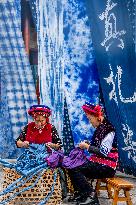
Duan Yinmei (R), an inheritor of the tie-dye technique of Bai ethnic group, and handicraftsman Duan Lilan create knots on fabrics in a dyehouse in Zhoucheng Village of Dali Bai Autonomous Prefecture, southwest China's Yunnan Province, November 21, 2025. Known as the hometown of the tie-dye technique of Bai ethnic group, Zhoucheng Village hosts over 200 households engaging in tie-dye businesses, with the number of employees exceeding 4,000. As a traditional folk technique of the Bai ethnic group, tie-dye boasts a history spanning over a thousand years and was included in the first batch of China's national intangible cultural heritage list in 2006. Tying and dyeing are the core steps in the process of making indigo tie-dye products. Artisans use needles and threads to create various patterns on the fabric, which are then dyed with plant-based dyes, resulting in blue backgrounds adorned with vivid white patterns. Photo by Hu Chao/Xinhua/ABACAPRESS.COM

  •  
Sumo: London tournament

Sumo: London tournament

Yokozuna Hoshoryu (R), winner of the five-day Grand Sumo Tournament, claps alongside Ura, who received both the Technique Prize and the audience award, at the Royal Albert Hall in London on Oct. 19, 2025.

  •  
Princess Kako visits Kyoto guesthouse

Princess Kako visits Kyoto guesthouse

Japanese Princess Kako is briefed about a kimono on display from Kunihiko Moriguchi, living national treasure for his mastery of "yuzen" resist dyeing technique, during a visit to a guesthouse operated by Panasonic Holdings Corp. in Kyoto on Oct. 9, 2025. (Pool photo)

  •  
Tuna Fishing in Barbate - Cadiz

Tuna Fishing in Barbate - Cadiz

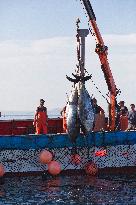
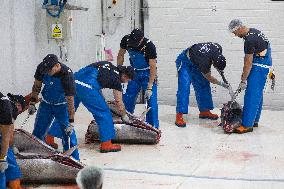
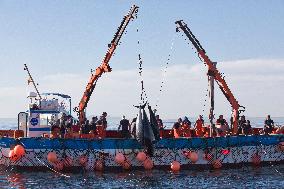
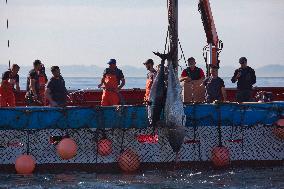
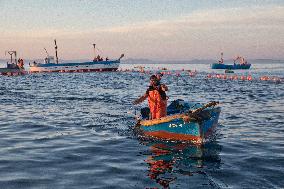
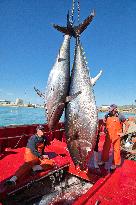
Several fishermen during the 'levantá' of tuna in the vicinity of Barbate, on May 27, 2025, in Barbate, Cadiz, Andalusia (Spain). The 'levantá' of Barbate is the culminating and most spectacular moment of traditional bluefin tuna fishing in the almadraba, an ancient art practiced every spring off the coast of Barbate (Cadiz). It consists of slowly raising the codend net, where the tuna have been trapped during their migration towards the Mediterranean, causing the large fish to emerge to the surface amidst flapping and foam, while the fishermen select and catch the largest specimens. Today, the technique has evolved: the divers sacrifice the tuna one by one with "luparas" (special poles), and the final lifting is done with cranes, although the ritual and collective nature of the process is preserved. Photo by Juanma Jiménez/Europa Press/ABACAPRESS.COM

  •  
Tuna Fishing in Barbate - Cadiz

Tuna Fishing in Barbate - Cadiz

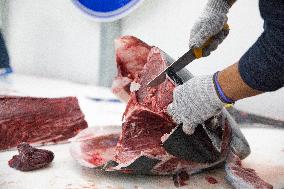
A man cuts up a tuna during the 'levantá' of tuna in the vicinity of Barbate, on May 27, 2025, in Barbate, Cadiz, Andalusia (Spain). The 'levantá' of Barbate is the culminating and most spectacular moment of the traditional fishing of bluefin tuna in the almadraba, an ancient art that is practiced every spring off the coast of Barbate (Cadiz). It consists of slowly raising the codend net, where the tuna have been trapped during their migration towards the Mediterranean, causing the large fish to emerge to the surface amidst flapping and foam, while the fishermen select and catch the largest specimens. Today, the technique has evolved: the divers sacrifice the tuna one by one with "luparas" (special poles), and the final lifting is done with cranes, although the ritual and collective nature of the process is preserved. Photo by Juanma Jiménez/Europa Press/ABACAPRESS.COM

  •  
Tuna Fishing in Barbate - Cadiz

Tuna Fishing in Barbate - Cadiz

Several fishermen during the 'levantá' of tuna in the vicinity of Barbate, on May 27, 2025, in Barbate, Cadiz, Andalusia (Spain). The 'levantá' of Barbate is the culminating and most spectacular moment of traditional bluefin tuna fishing in the almadraba, an ancient art practiced every spring off the coast of Barbate (Cadiz). It consists of slowly raising the codend net, where the tuna have been trapped during their migration towards the Mediterranean, causing the large fish to emerge to the surface amidst flapping and foam, while the fishermen select and catch the largest specimens. Today, the technique has evolved: the divers sacrifice the tuna one by one with "luparas" (special poles), and the final lifting is done with cranes, although the ritual and collective nature of the process is preserved. Photo by Juanma Jiménez/Europa Press/ABACAPRESS.COM

  •  
Tuna Fishing in Barbate - Cadiz

Tuna Fishing in Barbate - Cadiz

A man cuts up a tuna during the 'levantá' of tuna in the vicinity of Barbate, on May 27, 2025, in Barbate, Cadiz, Andalusia (Spain). The 'levantá' of Barbate is the culminating and most spectacular moment of the traditional fishing of bluefin tuna in the almadraba, an ancient art that is practiced every spring off the coast of Barbate (Cadiz). It consists of slowly raising the codend net, where the tuna have been trapped during their migration towards the Mediterranean, causing the large fish to emerge to the surface amidst flapping and foam, while the fishermen select and catch the largest specimens. Today, the technique has evolved: the divers sacrifice the tuna one by one with "luparas" (special poles), and the final lifting is done with cranes, although the ritual and collective nature of the process is preserved. Photo by Juanma Jiménez/Europa Press/ABACAPRESS.COM

  •  
Tuna Fishing in Barbate - Cadiz

Tuna Fishing in Barbate - Cadiz

Several fishermen during the 'levantá' of tuna in the vicinity of Barbate, on May 27, 2025, in Barbate, Cadiz, Andalusia (Spain). The 'levantá' of Barbate is the culminating and most spectacular moment of traditional bluefin tuna fishing in the almadraba, an ancient art practiced every spring off the coast of Barbate (Cadiz). It consists of slowly raising the codend net, where the tuna have been trapped during their migration towards the Mediterranean, causing the large fish to emerge to the surface amidst flapping and foam, while the fishermen select and catch the largest specimens. Today, the technique has evolved: the divers sacrifice the tuna one by one with "luparas" (special poles), and the final lifting is done with cranes, although the ritual and collective nature of the process is preserved. Photo by Juanma Jiménez/Europa Press/ABACAPRESS.COM

  •  
Tuna Fishing in Barbate - Cadiz

Tuna Fishing in Barbate - Cadiz

Several fishermen during the 'levantá' of tuna in the vicinity of Barbate, on May 27, 2025, in Barbate, Cadiz, Andalusia (Spain). The 'levantá' of Barbate is the culminating and most spectacular moment of traditional bluefin tuna fishing in the almadraba, an ancient art practiced every spring off the coast of Barbate (Cadiz). It consists of slowly raising the codend net, where the tuna have been trapped during their migration towards the Mediterranean, causing the large fish to emerge to the surface amidst flapping and foam, while the fishermen select and catch the largest specimens. Today, the technique has evolved: the divers sacrifice the tuna one by one with "luparas" (special poles), and the final lifting is done with cranes, although the ritual and collective nature of the process is preserved. Photo by Juanma Jiménez/Europa Press/ABACAPRESS.COM

  •  
Tuna Fishing in Barbate - Cadiz

Tuna Fishing in Barbate - Cadiz

Several fishermen during the 'levantá' of tuna in the vicinity of Barbate, on May 27, 2025, in Barbate, Cadiz, Andalusia (Spain). The 'levantá' of Barbate is the culminating and most spectacular moment of traditional bluefin tuna fishing in the almadraba, an ancient art practiced every spring off the coast of Barbate (Cadiz). It consists of slowly raising the codend net, where the tuna have been trapped during their migration towards the Mediterranean, causing the large fish to emerge to the surface amidst flapping and foam, while the fishermen select and catch the largest specimens. Today, the technique has evolved: the divers sacrifice the tuna one by one with "luparas" (special poles), and the final lifting is done with cranes, although the ritual and collective nature of the process is preserved. Photo by Juanma Jiménez/Europa Press/ABACAPRESS.COM

  •  
Tuna Fishing in Barbate - Cadiz

Tuna Fishing in Barbate - Cadiz

Several fishermen during the 'levantá' of tuna in the vicinity of Barbate, on May 27, 2025, in Barbate, Cadiz, Andalusia (Spain). The 'levantá' of Barbate is the culminating and most spectacular moment of traditional bluefin tuna fishing in the almadraba, an ancient art practiced every spring off the coast of Barbate (Cadiz). It consists of slowly raising the codend net, where the tuna have been trapped during their migration towards the Mediterranean, causing the large fish to emerge to the surface amidst flapping and foam, while the fishermen select and catch the largest specimens. Today, the technique has evolved: the divers sacrifice the tuna one by one with "luparas" (special poles), and the final lifting is done with cranes, although the ritual and collective nature of the process is preserved. Photo by Juanma Jiménez/Europa Press/ABACAPRESS.COM

  •  
Vatican’s Ecological Project In The Pope’s Gardens in Castel Gandolfo

Vatican’s Ecological Project In The Pope’s Gardens in Castel Gandolfo

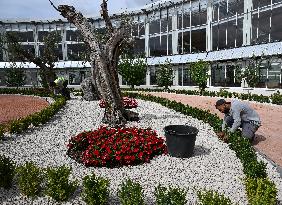
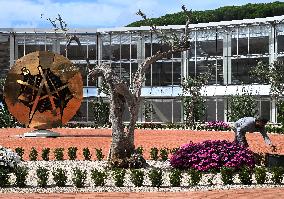
View of the greenhouse at the Advanced Training Centre', a new Vatican-run ecological training centre located within the papal estate at Castel Gandolfo, near Rome, Italy on September 2, 2025, ahead of Pope Leo XIV's inauguration. Located on the area of the Pontifical villa, gardens and farms of Castel Gandolfo, the ‘Borgo Laudato Si' offers a richly biodiverse environment (with more than 3,000 plants from 300 species), providing visitors with an immersive experience in natural beauty. Borgo Laudato Si’ includes 55 hectares of extraterritorial area, divided into 35 hectares of magnificent gardens and 20 hectares of agricultural and farming land, greenhouses and service buildings that the Borgo is committed to preserving and developing with loving care, by also adding to the investment on education the essential commitment to foster the culture of care. Regarding the gardens area, the Borgo is entrusted with their preservation, maintenance, care, and at the same time development, by also applying new technique

  •  
Vatican’s Ecological Project In The Pope’s Gardens in Castel Gandolfo

Vatican’s Ecological Project In The Pope’s Gardens in Castel Gandolfo

View of the greenhouse at the Advanced Training Centre', a new Vatican-run ecological training centre located within the papal estate at Castel Gandolfo, near Rome, Italy on September 2, 2025, ahead of Pope Leo XIV's inauguration. Located on the area of the Pontifical villa, gardens and farms of Castel Gandolfo, the ‘Borgo Laudato Si' offers a richly biodiverse environment (with more than 3,000 plants from 300 species), providing visitors with an immersive experience in natural beauty. Borgo Laudato Si’ includes 55 hectares of extraterritorial area, divided into 35 hectares of magnificent gardens and 20 hectares of agricultural and farming land, greenhouses and service buildings that the Borgo is committed to preserving and developing with loving care, by also adding to the investment on education the essential commitment to foster the culture of care. Regarding the gardens area, the Borgo is entrusted with their preservation, maintenance, care, and at the same time development, by also applying new technique

  •  
Vatican’s Ecological Project In The Pope’s Gardens in Castel Gandolfo

Vatican’s Ecological Project In The Pope’s Gardens in Castel Gandolfo

View of the greenhouse at the Advanced Training Centre', a new Vatican-run ecological training centre located within the papal estate at Castel Gandolfo, near Rome, Italy on September 2, 2025, ahead of Pope Leo XIV's inauguration. Located on the area of the Pontifical villa, gardens and farms of Castel Gandolfo, the ‘Borgo Laudato Si' offers a richly biodiverse environment (with more than 3,000 plants from 300 species), providing visitors with an immersive experience in natural beauty. Borgo Laudato Si’ includes 55 hectares of extraterritorial area, divided into 35 hectares of magnificent gardens and 20 hectares of agricultural and farming land, greenhouses and service buildings that the Borgo is committed to preserving and developing with loving care, by also adding to the investment on education the essential commitment to foster the culture of care. Regarding the gardens area, the Borgo is entrusted with their preservation, maintenance, care, and at the same time development, by also applying new technique

  •  
Vatican’s Ecological Project In The Pope’s Gardens in Castel Gandolfo

Vatican’s Ecological Project In The Pope’s Gardens in Castel Gandolfo

View of the greenhouse at the Advanced Training Centre', a new Vatican-run ecological training centre located within the papal estate at Castel Gandolfo, near Rome, Italy on September 2, 2025, ahead of Pope Leo XIV's inauguration. Located on the area of the Pontifical villa, gardens and farms of Castel Gandolfo, the ‘Borgo Laudato Si' offers a richly biodiverse environment (with more than 3,000 plants from 300 species), providing visitors with an immersive experience in natural beauty. Borgo Laudato Si’ includes 55 hectares of extraterritorial area, divided into 35 hectares of magnificent gardens and 20 hectares of agricultural and farming land, greenhouses and service buildings that the Borgo is committed to preserving and developing with loving care, by also adding to the investment on education the essential commitment to foster the culture of care. Regarding the gardens area, the Borgo is entrusted with their preservation, maintenance, care, and at the same time development, by also applying new technique

  •  
Vatican’s Ecological Project In The Pope’s Gardens in Castel Gandolfo

Vatican’s Ecological Project In The Pope’s Gardens in Castel Gandolfo

View of the greenhouse at the Advanced Training Centre', a new Vatican-run ecological training centre located within the papal estate at Castel Gandolfo, near Rome, Italy on September 2, 2025, ahead of Pope Leo XIV's inauguration. Located on the area of the Pontifical villa, gardens and farms of Castel Gandolfo, the ‘Borgo Laudato Si' offers a richly biodiverse environment (with more than 3,000 plants from 300 species), providing visitors with an immersive experience in natural beauty. Borgo Laudato Si’ includes 55 hectares of extraterritorial area, divided into 35 hectares of magnificent gardens and 20 hectares of agricultural and farming land, greenhouses and service buildings that the Borgo is committed to preserving and developing with loving care, by also adding to the investment on education the essential commitment to foster the culture of care. Regarding the gardens area, the Borgo is entrusted with their preservation, maintenance, care, and at the same time development, by also applying new technique

  •  
Vatican’s Ecological Project In The Pope’s Gardens in Castel Gandolfo

Vatican’s Ecological Project In The Pope’s Gardens in Castel Gandolfo

View of the greenhouse at the Advanced Training Centre', a new Vatican-run ecological training centre located within the papal estate at Castel Gandolfo, near Rome, Italy on September 2, 2025, ahead of Pope Leo XIV's inauguration. Located on the area of the Pontifical villa, gardens and farms of Castel Gandolfo, the ‘Borgo Laudato Si' offers a richly biodiverse environment (with more than 3,000 plants from 300 species), providing visitors with an immersive experience in natural beauty. Borgo Laudato Si’ includes 55 hectares of extraterritorial area, divided into 35 hectares of magnificent gardens and 20 hectares of agricultural and farming land, greenhouses and service buildings that the Borgo is committed to preserving and developing with loving care, by also adding to the investment on education the essential commitment to foster the culture of care. Regarding the gardens area, the Borgo is entrusted with their preservation, maintenance, care, and at the same time development, by also applying new technique

  •  
Vatican’s Ecological Project In The Pope’s Gardens in Castel Gandolfo

Vatican’s Ecological Project In The Pope’s Gardens in Castel Gandolfo

View of the greenhouse at the Advanced Training Centre', a new Vatican-run ecological training centre located within the papal estate at Castel Gandolfo, near Rome, Italy on September 2, 2025, ahead of Pope Leo XIV's inauguration. Located on the area of the Pontifical villa, gardens and farms of Castel Gandolfo, the ‘Borgo Laudato Si' offers a richly biodiverse environment (with more than 3,000 plants from 300 species), providing visitors with an immersive experience in natural beauty. Borgo Laudato Si’ includes 55 hectares of extraterritorial area, divided into 35 hectares of magnificent gardens and 20 hectares of agricultural and farming land, greenhouses and service buildings that the Borgo is committed to preserving and developing with loving care, by also adding to the investment on education the essential commitment to foster the culture of care. Regarding the gardens area, the Borgo is entrusted with their preservation, maintenance, care, and at the same time development, by also applying new technique

  •  
Youth Tech Carnival in Wuzhen Zhejiang - China

Youth Tech Carnival in Wuzhen Zhejiang - China

A boy experiences brain science technique at the Wuzhen Youth Tech Carnival in Wuzhen, east China's Zhejiang Province, on Aug. 17, 2025. The first Wuzhen Youth Tech Carnival is held from Aug. 15 to 25 in Wuzhen of Tongxiang City. This 11-day technology event, bringing together more than 40,000 young technology enthusiasts from all over the world, builds up a comprehensive platform for teenagers to show wisdom, boost innovation and touch the future. Photo by Xu Yu/Xinhua/ABACAPRESS.COM

  •  
Youth Tech Carnival in Wuzhen Zhejiang - China

Youth Tech Carnival in Wuzhen Zhejiang - China

A boy experiences brain science technique at the Wuzhen Youth Tech Carnival in Wuzhen, east China's Zhejiang Province, on Aug. 17, 2025. The first Wuzhen Youth Tech Carnival is held from Aug. 15 to 25 in Wuzhen of Tongxiang City. This 11-day technology event, bringing together more than 40,000 young technology enthusiasts from all over the world, builds up a comprehensive platform for teenagers to show wisdom, boost innovation and touch the future. Photo by Xu Yu/Xinhua/ABACAPRESS.COM

  •  
Kumamon visits quake-hit city in Ishikawa Pref.

Kumamon visits quake-hit city in Ishikawa Pref.

Kumamon, the official mascot of the southwestern Japan prefecture of Kumamoto, makes chopsticks using a Wajima-nuri lacquerware technique at a facility in Wajima, an Ishikawa Prefecture city hit hard by the Jan. 1, 2024, massive earthquake, on Aug. 9, 2025. Kumamon is visiting various Ishikawa Prefecture cities to give encouragement to people affected by the disaster.

  •  
Arcachon

Arcachon

FRANCE. GIRONDE (33) BASSIN D'ARCACHON. CIRCUMPOLAR, STARRY SKY, ON THE DUNE DU PILAT. THIS PHOTOGRAPHIC TECHNIQUE INVOLVES TAKING ONE OR MORE LONG EXPOSURE PHOTOS TO REVEAL THE ROTATION OF THE CELESTIAL VAULT. Photo by Michael Portillo/Only France/ABACAPRESS.COM

  •  
Guidong Pottery Making - China

Guidong Pottery Making - China

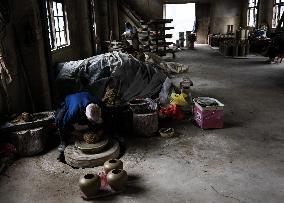
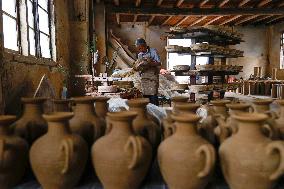
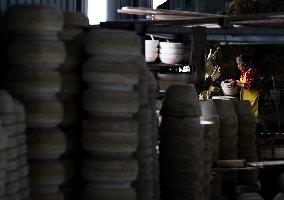
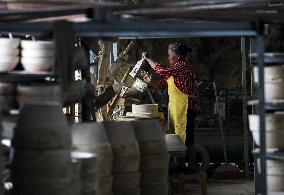
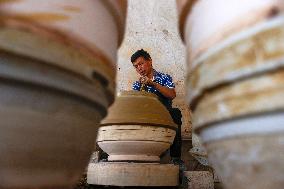
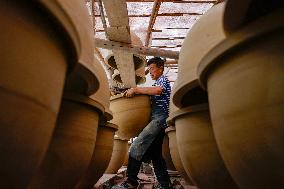
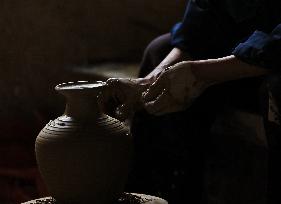
Fang Liangsheng, a pottery artisan, makes a piece of pottery in Pule Town, Guidong County, central China's Hunan Province, June 17, 2025. Pule Town boasts a rich history of pottery production. Artisans in the town follow the traditional clay pottery production technique and develop a series of new products, bringing new vitality to the crafts. Photo by Lan Hongguang/Xinhua/ABACAPRESS.COM

  •  
Guidong Pottery Making - China

Guidong Pottery Making - China

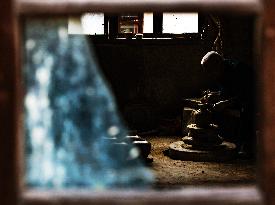
A pottery maker makes a piece of pottery in Pule Town, Guidong County, central China's Hunan Province, June 17, 2025. Pule Town boasts a rich history of pottery production. Artisans in the town follow the traditional clay pottery production technique and develop a series of new products, bringing new vitality to the crafts. Photo by Guo Liliang/Xinhua/ABACAPRESS.COM

  •  
Guidong Pottery Making - China

Guidong Pottery Making - China

Deng Zhaochai, a pottery artisan, makes a piece of pottery in Pule Town, Guidong County, central China's Hunan Province, June 17, 2025. Pule Town boasts a rich history of pottery production. Artisans in the town follow the traditional clay pottery production technique and develop a series of new products, bringing new vitality to the crafts. Photo by Lan Hongguang/Xinhua/ABACAPRESS.COM

  •  
Guidong Pottery Making - China

Guidong Pottery Making - China

Deng Zhaochai, a pottery artisan, makes a piece of pottery in Pule Town, Guidong County, central China's Hunan Province, June 17, 2025. Pule Town boasts a rich history of pottery production. Artisans in the town follow the traditional clay pottery production technique and develop a series of new products, bringing new vitality to the crafts. Photo by Lan Hongguang/Xinhua/ABACAPRESS.COM

  •  
Guidong Pottery Making - China

Guidong Pottery Making - China

Deng Zhaochai, a pottery artisan, makes a piece of pottery in Pule Town, Guidong County, central China's Hunan Province, June 17, 2025. Pule Town boasts a rich history of pottery production. Artisans in the town follow the traditional clay pottery production technique and develop a series of new products, bringing new vitality to the crafts. Photo by Lan Hongguang/Xinhua/ABACAPRESS.COM

  •  
Guidong Pottery Making - China

Guidong Pottery Making - China

Fang Liangsheng, a pottery artisan, makes a piece of pottery in Pule Town, Guidong County, central China's Hunan Province, June 17, 2025. Pule Town boasts a rich history of pottery production. Artisans in the town follow the traditional clay pottery production technique and develop a series of new products, bringing new vitality to the crafts. Photo by Lan Hongguang/Xinhua/ABACAPRESS.COM

  •  
Guidong Pottery Making - China

Guidong Pottery Making - China

Fang Jianfei, a pottery artisan, makes a piece of pottery in Pule Town, Guidong County, central China's Hunan Province, June 17, 2025. Pule Town boasts a rich history of pottery production. Artisans in the town follow the traditional clay pottery production technique and develop a series of new products, bringing new vitality to the crafts. Photo by Guo Liliang/Xinhua/ABACAPRESS.COM

  •  
Guidong Pottery Making - China

Guidong Pottery Making - China

Fang Liangsheng, a pottery artisan, makes a piece of pottery in Pule Town, Guidong County, central China's Hunan Province, June 17, 2025. Pule Town boasts a rich history of pottery production. Artisans in the town follow the traditional clay pottery production technique and develop a series of new products, bringing new vitality to the crafts. Photo by Lan Hongguang/Xinhua/ABACAPRESS.COM

  •  
Guidong Pottery Making - China

Guidong Pottery Making - China

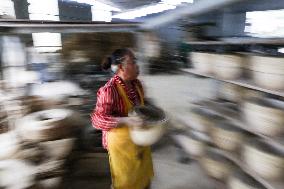
Fang Jianfei, a pottery artisan, carries a piece of pottery in Pule Town, Guidong County, central China's Hunan Province, June 17, 2025. Pule Town boasts a rich history of pottery production. Artisans in the town follow the traditional clay pottery production technique and develop a series of new products, bringing new vitality to the crafts. Photo by Guo Liliang/Xinhua/ABACAPRESS.COM

  •  
Guidong Pottery Making - China

Guidong Pottery Making - China

Fang Liangsheng, a pottery artisan, makes a piece of pottery in Pule Town, Guidong County, central China's Hunan Province, June 17, 2025. Pule Town boasts a rich history of pottery production. Artisans in the town follow the traditional clay pottery production technique and develop a series of new products, bringing new vitality to the crafts. Photo by Lan Hongguang/Xinhua/ABACAPRESS.COM

  •  
Guidong Pottery Making - China

Guidong Pottery Making - China

Fang Liangsheng, a pottery artisan, makes a piece of pottery in Pule Town, Guidong County, central China's Hunan Province, June 17, 2025. Pule Town boasts a rich history of pottery production. Artisans in the town follow the traditional clay pottery production technique and develop a series of new products, bringing new vitality to the crafts. Photo by Lan Hongguang/Xinhua/ABACAPRESS.COM

  •  
Guidong Pottery Making - China

Guidong Pottery Making - China

Fang Liangsheng, a pottery artisan, makes a piece of pottery in Pule Town, Guidong County, central China's Hunan Province, June 17, 2025. Pule Town boasts a rich history of pottery production. Artisans in the town follow the traditional clay pottery production technique and develop a series of new products, bringing new vitality to the crafts. Photo by Lan Hongguang/Xinhua/ABACAPRESS.COM

  • Main
  • Top
  • Editorial
  • Creative
  • About Us
  • About ILG
  • Terms of use
  • Company
  • BEHIND
  • Price List
  • Single Plan
  • Monthly Plan
  • Services
  • Shooting
  • Rights Clearance
  • Support
  • FAQ
  • How To Buy
  • Contact Us
  • Become a Partner

© KYODO NEWS IMAGES INC

All Rights Reserved.

  • Editorial
  • Olympics
  • News
  • Sports
  • Japan
  • Tech
  • Royal
  • Disaster
  • NorthKorea
  • Old Japan
  • SNS

  • Creative
  • Food
  • Japan
  • Landscape
  • Animal
  • Popular
  • #Ukraine
  • #Thailand
  • #coronavirus
  • #N. Korea
  • #Russia
  • #China
  • #Ukraine
  • #Thailand
  • #coronavirus
  • #N. Korea
  • #Russia
  • #China
  • Food
  • Japan
  • Landscape
  • Animal
  • Olympics
  • News
  • Sports
  • Japan
  • Tech
  • Royal
  • Disaster
  • NorthKorea
  • Old Japan
  • SNS